
VASUDHAIVA KUTUMBAKAM VII
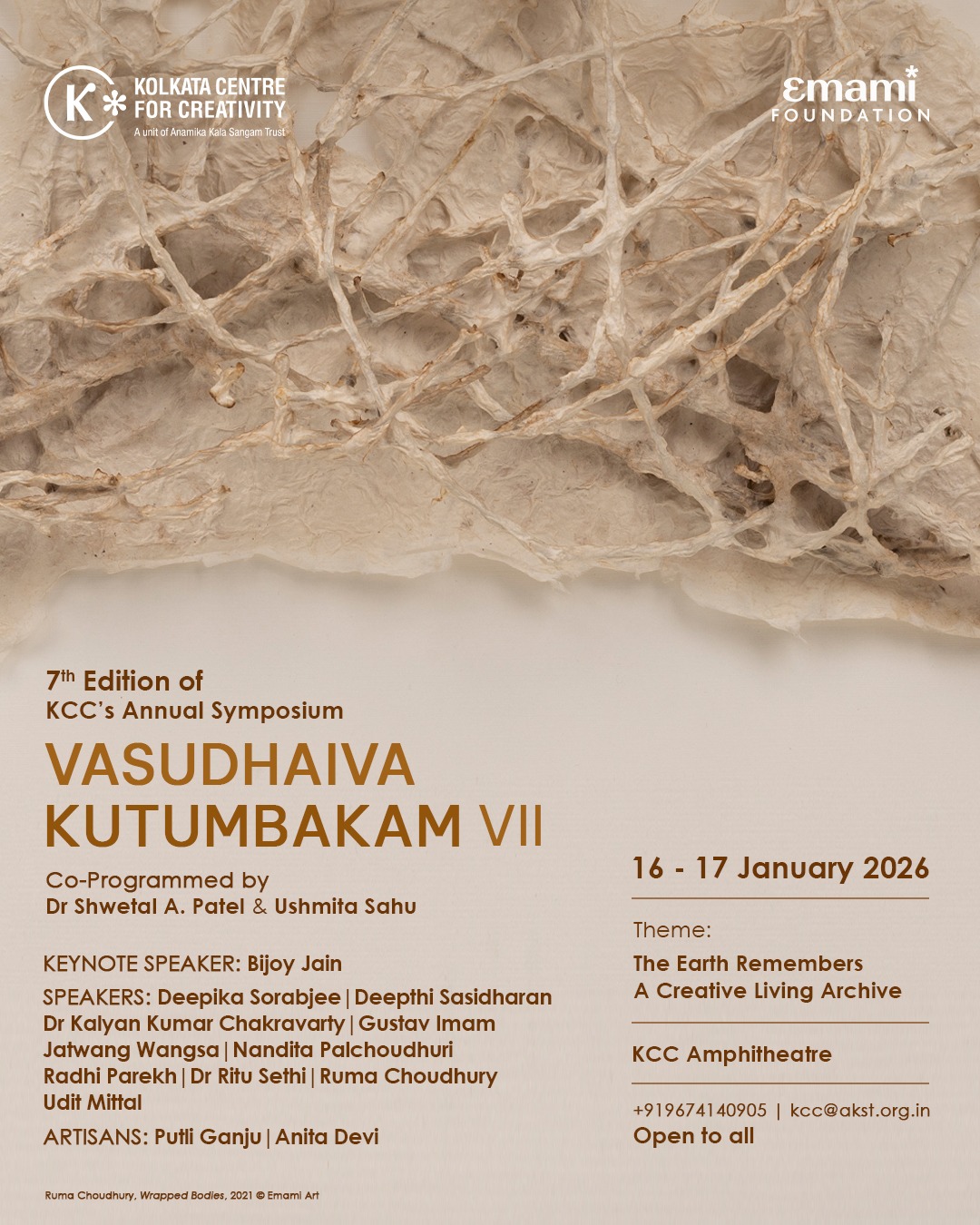
Dates: 16 & 17 January 2026
Time: 11:00 AM – 7:00 PM
Venue: KCC Amphitheatre
Theme: The Earth Remembers: A Creative Living Archive
Co-programmed by Dr Shwetal A. Patel and Ms. Ushmita Sahu
KCC presents the 7th edition of its annual symposium Vasudhaiva Kutumbakam (VK) with the theme being ‘The Earth Remembers: A Creative Living Archive’ scheduled for 16-17 January 2026 at Kolkata Centre for Creativity, Kolkata.
The two-day programming aims to bring together leading figures and contemporary practitioners – advancing conversations across art, craft, design, architecture, ecology, and community practices. This year, VK will focus on a region underrepresented in India’s cultural mainstream: Eastern and Northeastern India. This vast geography – home to vibrant indigenous communities, old and newly expanding urban centres, rich biodiversity, and deeply rooted artistic and craft traditions – offers vital, alternative models of sustainability, cultural resilience, and collective living. At VK VII, through illustrated presentations, conversations, panel discussions, screenings, audience integration, workshops, and more, we seek to amplify these perspectives.
Speakers: Bijoy Jain (keynote speaker) | Deepika Sorabjee | Deepthi Sasidharan | Gustav Imam | Jatwang Wangsa | Dr Kalyan Kumar Chakravarty | Nandita Palchoudhuri | Radhi Parekh | Dr Ritu Sethi | Ruma Choudhury | Udit Mittal
Artisans (supporting Gustav Imam’s session): Putli Ganju | Anita Devi
ABOUT THE SPEAKERS AND ARTISANS
Anita Devi is a Khovar artist from the village of Kharati in the Barkagaon Valley, well-known for its Khovar paintings. Born in a potter’s family, she learned the art of making Khovar paintings from her mother, late Jasodha Devi. Anita Devi has developed herself as a professional artist travelling and exhibiting her art across India and abroad through the Tribal Women Artists Cooperative (TWAC) under the guidance of Padmashri Bulu Imam. Recently she painted a large Khovar mural at the National Gallery of Modern Art in Kolkata, along with Putli Ganju.
Bijoy Jain trained as an architect and started his practice in 1996. He founded Studio Mumbai in 2005 as an interdisciplinary practice. His work explores the boundaries between architecture, art, and the notion of movement, body as material and making. His works are part of the collection at Foundation Cartier and Centre Pompidou, Paris; SF MoMa; and MAAS, Sydney. In 2017, he received the RIBA International Fellowship in London, the Alvar Aalto medal in 2021, and the Prix AMO in 2025 for the winery Chateau Beaucastel described as “a sublime project” by the jury.
Deepika Sorabjee holds an MBBS from the Grant Medical College and the Sir J.J. Group of Hospitals, Mumbai. She has worked primarily in arts programming and has written on contemporary art for various publications, online sites, newspapers, and art journals. Between 2014 and 2023, she led the Arts & Culture Portfolio at Tata Trusts, helming programs in conservation, art education, and performing arts. A member of several juries, she was also the founder-trustee of the non-profit Mumbai Art Room, and on the Board of the Chhatrapati Shivaji Maharaj Vastu Sangrahalaya, Mumbai (2015-2023).
Deepthi Sasidharan is an art historian, curator, and the Founder-Director of Eka Archiving, India’s leading cultural consultancy working across museums, corporate archives, heritage, and training. Under her leadership, notable projects by Eka include Rezwan Razack Museum of Indian Paper Money, Bengaluru; Dr Savita Museum and Library, Porbandar; and Emami Legacy Center, Kolkata, among others. A Fulbright and Fundação Oriente scholar, and INK Fellow, Sasidharan has extensively researched, curated, and written on 19th-century photography, contributing to the understanding of visual culture in colonial India. Her work bridges scholarship, design, and storytelling in the cultural sector.
Gustav Imam is the Convener of the Indian National Trust for Art and Cultural Heritage - Hazaribagh Chapter and Curator of the Sanskriti Museum and Art Gallery, Hazaribagh, Jharkhand. Drawn to the critical potentials of museum practices in preserving indigenous cultures, he holds an MA in Museum Studies from the University of East Anglia (UK) and has done a Museum Placement at the University of Cambridge’s Museum of Archaeology and Anthropology. His work with the Tribal Women Artists Cooperative gave him a chance to engage with the tribal communities practicing Khovar and mural painting traditions in Hazaribagh.
Writer and educator Jatwang Wangsa teaches at the government school in Kamhua Noknu, Arunachal Pradesh. He has contributed to Folktales of Arunachal Pradesh, The Heroes of Arunachal, and Arun Utsav: The Festivals of Arunachal Pradesh at workshops by SCERT and ISSE, and the Wancho third-language textbook; co-authored Myth, Memory and Folktales of the Wancho Tribe of Arunachal Pradesh pub. Niyogi Books (2024); and was a local collaborator for the Endangered Wooden Architecture Project focusing on traditional Wancho houses, supported by Oxford Brookes University, London. He initiated Tamkai-Kam, the first-ever ethnographic museum dedicated to preserving Wancho traditions and culture.
Dr Kalyan Kumar Chakravarty, IAS (retired Secretary, Govt. of India), holds an M.A. (Kolkata), an M.P.A. (Harvard), and a Ph.D. in Fine Arts (Harvard). He is the President of the People’s Council of Education and distinguished Professor at Centurion University of Technology and Management, Odisha. Formerly Chairman of Lalit Kala Akademi, New Delhi and Director-General of the National Museum, New Delhi, Dr Chakravarty has played an instrumental role in various cultural and heritage management initiatives in India and abroad. His works focus on the intersection of culture, governance, and sustainable development.
Nandita Palchoudhuri is a social entrepreneur curating and consulting internationally, in the field of Indian folk art, craft, and performance practices. Through her work, large scale craft-based projects using Chandannagar lights, sholapith sculpture, giant animal puppets, Kumartuli clay images, storytelling scrolls of Naya have been presented across India and internationally. A Clore-Chevening Scholar in Cultural Leadership, Palchoudhuri is Ex Chairperson and Trustee, India Foundation for the Arts; Member, FICCI - Art; Culture Committee, Ford Foundation - International Initiative for Social Philanthropy; and Trustee, Academy of Fine Arts, Calcutta School of Music, and Alliance Francaise, amongst others.
Putli Ganju is an internationally acclaimed artist who has exhibited and worked widely in Australia, Europe, England, and Canada. Taught by her mother Bigni, Putli Ganju paints in the Ganju style and has since 1995 has been a resident of the Tribal Women Artists’ Cooperative founded by Bulu Imam at Sanskriti Centre in Hazaribagh. Her Sohrai mural Hunting Scene is placed in the Art Gallery of New South Wales; Animals in the Australian Museum, Sydney; and Jungle Scene was acquired for the permanent collection of the National Gallery of Canada, Ottawa.
Radhi Parekh is Founder Director of ARTISANS’ Centre for the Creative Arts. She is a graduate of the National Institute of Design (NID), India with a career in design spanning two decades, three continents, and evolving technologies, championing localization to build truly global products. From designing and illustrating books for children at Usborne Publishing, London; to multimedia games for children in San Francisco; to the first web applications at Oracle; and online user-experiences at eBay/PayPal, she is a passionate advocate of human-centered design. Parekh teaches design at premiere institutions in India.
Dr Ritu Sethi is the editor of Global InCH Journal of Living Heritage and oversees the Asia InCH Encyclopaedia. Her research interests examine aspects of pre and post-colonial cultural histories of the arts, crafts and textiles, their continuities and interpretations in policy, design, fashion, and the everyday. Her publications include Handmade for the 21st Century: Traditional Indian Textiles; Embroidering Futures - Repurposing the Kantha; and Painters, Poets, Performers – The Patuas of Bengal. She serves on the advisory board of the National Crafts Museum, New Delhi; Asia Society India – Arts and Culture; and on committees in Japan, UK, and Europe.
Contemporary artist and independent researcher Ruma Choudhury holds a BFA and an MFA in Painting from Kala Bhavana, Visva-Bharati, Santiniketan. Notable group exhibitions include Material as Metaphors, NGMA, Kolkata, 2025; There are Tides in the Body, Emami Art, Kolkata, 2024; All That is Hidden, Emami Art, Kolkata, 2024; Departure, Ganges Art Gallery, Kolkata, 2020; while her solo performances include h-airy strokes at Gallery Onkaf, New Delhi and Multi Hues, Lalit Kala Akademi, New Delhi, 2018. She received the India Artist Relief Fund 2021 and the Musui Art Foundation Scholarship 2020, among others.
Udit Mittal is the Principal Architect of QX Design, an award-winning architecture practice based in Kolkata, known for its contextual, bioclimatic, and material-driven design approach. An alumnus of School of Planning and Architecture, Delhi, with over a decade of practice, Mittal’s work has been widely published and celebrated across India’s design community. He has won multiple accolades including Glitz Design Honour 2025 – Hospitality Architecture; Smart Design Conclave Winner 2025 – Sustained Ecology & Hospitality; and Best Hospitality Architect – Sustainable Design, for the Sunderbans project, awarded by Everest Next Gen Sustainable Architects.
